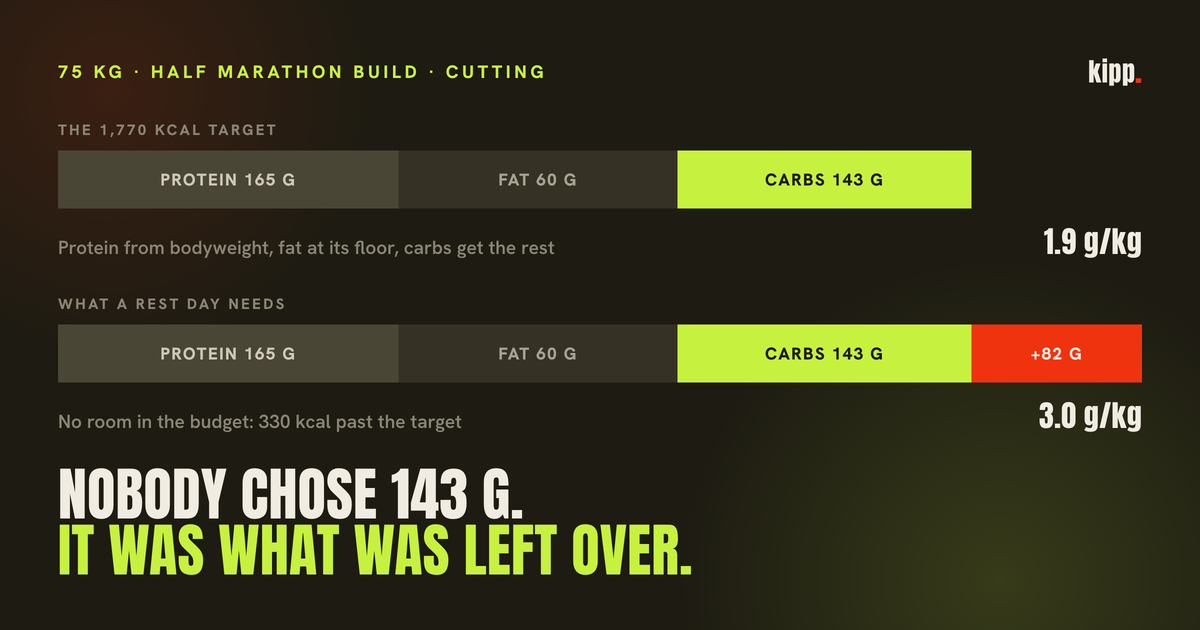
An athlete on our roster is building toward a half marathon. They weigh 75 kg, they are in a deficit, and their app gives them a daily carbohydrate target of 143 g. That is 1.9 g per kilogram of bodyweight.
The joint position stand from the American College of Sports Medicine, the Academy of Nutrition and Dietetics and Dietitians of Canada puts a runner training one to three hours a day at 6-10 g/kg. That is under a third of the bottom of that range, and nobody chose the number. It is what was left after two other numbers were decided.
The short answer
Your carb target is a remainder, not a recommendation. A macro calculator sets protein from your bodyweight, sets fat from a percentage of calories or a per-kg floor, and gives carbohydrate whatever energy is left over. Protein and fat hardly move when you cut, so the entire deficit is subtracted from the one macro that fuels your session. Below roughly 28 kcal/kg/day you cannot reach a rest-day carbohydrate intake without also cutting protein, and below about 25.6 kcal/kg/day no split of the budget reaches it at all. The fix is the calorie target, not the macro ratio.
Carbs are what is left in the envelope
Here is the whole calculation, as our own code runs it. Four steps, in order:
- Estimate resting metabolic rate from bodyweight, height, age and sex.
- Multiply by an activity factor, then apply the goal. Our cut is
RMR x 1.55 x 0.8. - Set protein at 2.2 g/kg on a cut, and fat at the greater of 25% of calories or 0.8 g/kg.
- Carbohydrate gets whatever calories remain, divided by four.
For that 75 kg runner, at a 1,770 kcal target:
| Grams | Calories | How it was set | |
|---|---|---|---|
| Protein | 165 g | 660 | 2.2 g/kg, from bodyweight |
| Fat | 60 g | 540 | the 0.8 g/kg floor, not the 25% rule |
| Carbohydrate | 143 g | 570 | whatever was left |
| Total | 1,770 |
Protein is pinned to bodyweight. Fat has hit its floor. Neither of them notices the deficit. So when the calorie target came down, all of it came out of the third row.
This is the ordering our code uses, and I can read it. I cannot audit what MyFitnessPal or MacroFactor do internally, so read the generalisation as an inference from the shape of their outputs rather than a claim about their source: any calculator that fixes protein per kilogram and fat as a percentage or a floor has to give carbohydrate the remainder, because something has to absorb the deficit.
The obvious fix does nothing
The intuitive response is that this is a macro-split problem. Move some calories out of fat and into carbohydrate, and the target comes up. We measured that before writing the check, and it does not work.
Take it out of fat. To fund 3 g/kg of carbohydrate out of that same 1,770 kcal, holding protein, fat would have to fall to 23 g, which is 0.31 g/kg. Across the six athletes where this fires, the required fat intake lands between 0.31 and 0.51 g/kg, against roughly 0.8 g/kg used as a health minimum. Fat is at its floor precisely because the calories are tight. It is a symptom of the same constraint, not a spare resource.
Take it out of protein, then. Our 2.2 g/kg sits inside the range Helms and colleagues arrived at for lean athletes in a deficit, 1.8-2.7 g/kg, and their review also found intakes above about 2.4 g/kg unlikely to add further protein-sparing benefit. So there is genuine room to move down. It still does not close the gap. Dropping every one of the six to 1.6 g/kg, below the bottom of that deficit range and about as low as athlete guidance goes, and holding fat at 0.8 g/kg, their best possible carbohydrate intake becomes 2.50 to 2.94 g/kg. All six are still short of 3.
That gives a threshold worth remembering, because it falls straight out of the arithmetic. To fit a 3 g/kg carbohydrate intake alongside a 0.8 g/kg fat floor, you need:
- 28.0 kcal/kg/day at 2.2 g/kg protein
- 25.6 kcal/kg/day at 1.6 g/kg protein, which is already lower than a cutting athlete should go
Every one of the six sits at or below 25.4 kcal/kg. There is no legal arrangement of their macros that reaches a rest-day carbohydrate intake, which is why the check reports the calorie target rather than proposing a new split.
The heavier you are, the further under you land
On a formula cut with fat at its floor, the carb target collapses to a single line of algebra. Substituting the four steps above:
carbs per kg = 0.31 x (RMR per kg) - 4
Nothing else survives. Carb g/kg is a linear function of resting metabolic rate per kilogram of bodyweight and nothing else, so reaching 3 g/kg requires an RMR of at least 22.58 kcal per kg per day.
That is the part worth sitting with. RMR per kilogram falls as bodyweight rises, because the height and age terms in the Mifflin-St Jeor equation are divided by a larger number. So the same formula puts heavier athletes further below the carbohydrate floor. Ten athletes on our roster are on the untouched cut formula, and their carb targets order themselves perfectly by RMR per kg:
| RMR per kg | Bodyweight | Carb target |
|---|---|---|
| 19.00 | 75 kg | 1.91 g/kg |
| 19.56 | 118 kg | 2.07 g/kg |
| 19.91 | 97 kg | 2.17 g/kg |
| 20.18 | 79 kg | 2.27 g/kg |
| 20.21 | 94 kg | 2.27 g/kg |
| 20.45 | 95 kg | 2.35 g/kg |
| 21.15 | 72 kg | 2.54 g/kg |
| 21.55 | 91 kg | 2.67 g/kg |
| 21.87 | 67 kg | 2.79 g/kg |
| 22.07 | 64 kg | 2.83 g/kg |
The closest anyone gets is 22.07 against the 22.58 needed. Not one athlete on a formula cut clears it. The 118 kg swimmer, who needs the most absolute carbohydrate of anyone in the group, gets 2.07 g/kg.
What we actually measured
Thirty-eight profiles. Eleven have no stored macro targets, and one carries an implausible bodyweight of 35.3 kg at 151 cm, which is a data-entry problem rather than an athlete, and is excluded. That leaves 26 assessable, of whom 20 read as endurance or hybrid athletes.
Of those 20, 10 have a carb target below 3 g/kg, and 6 are below 2.5 g/kg, which is where our check fires. The range across endurance athletes runs from 1.91 to 5.82 g/kg. Closing the gap for the six would take between 160 and 442 extra calories a day.
Small sample, one app, one formula. I am not claiming a population rate, and the honest reading is that this is what one particular calculation does to one particular roster.
Two caveats that matter more than the counts. First, this is a statement about targets, not about eating: an athlete can be handed 143 g and eat 250 g, and several probably do. Second, the check says nothing about strength-only athletes, deliberately, because the carbohydrate case for them is a different argument.
One athlete is in both this group and the group from our piece on calorie targets below BMR. That athlete is 61.6 kg at 148 cm, coach-pinned at 1,500 kcal, and clears the energy-availability check by 6 kcal a day. That article reported the margin as 2.4 kcal, and it has drifted since, because both sides of the comparison move with bodyweight. A check passed by a rounding error is not really a pass, and their carb target is 2.2 g/kg.
Is 3 g/kg actually a floor?
It is worth arguing against ourselves here, because training with low carbohydrate availability is not automatically a mistake.
Carbohydrate periodisation is a real and studied strategy. The sleep-low model deliberately does a glycogen-depleting session, restricts carbohydrate overnight, then trains easy the next morning in that state, with the aim of amplifying the training signal. Some trials report improved economy and 10 km performance. A systematic review and meta-analysis in the Journal of the International Society of Sports Nutrition is more measured, and the fair summary is that there is no solid evidence of long-term performance benefit, particularly in elite athletes.
But notice what periodisation actually is. Some days are low, key days are fully fuelled, and somebody decided which is which. That is the opposite of what a standing target does. A calorie-constrained carb target is low every day, including the morning of the long run, and no one chose it.
The distinction matters because chronically low carbohydrate availability carries a cost that a well-timed low session does not. It is associated with poorer bone health, reduced immune function and iron depletion, and it is one of the routes into relative energy deficiency in sport. I am reporting an association from the literature, not diagnosing anybody, and if this describes you it is a conversation for a doctor or a sports dietitian rather than an app.
What to do with a constrained target
The rule our coach follows, and a reasonable one to apply by hand:
- Read the standing number as a floor for easy days, not a prescription for every day. It is a weekly average derived from a budget. On a long or hard session, or the day before a key one, the g/kg guidance wins.
- Never close the gap by cutting fat. On a cut it is already at its minimum, which is the reason the carbs are short in the first place.
- Fuel the session in front of you separately. For continuous efforts past about 75-90 minutes, carbohydrate during the session is its own decision, in grams per hour, and it is not really governed by the daily target at all.
- If sessions are consistently flat, treat the calorie target as the thing to change. That is the only lever that actually moves, and it is a decision to make deliberately rather than to discover in a macro breakdown.
The uncomfortable version, which our own numbers support: if you are building for an endurance event and your target is under about 28 kcal/kg/day, you are choosing between the deficit and the fuelling. You cannot have both, and no macro split will hide it.
Sources
- Nutrition and Athletic Performance, joint position stand of the Academy of Nutrition and Dietetics, Dietitians of Canada and the American College of Sports Medicine, 2016. Daily carbohydrate targets by training load, carbohydrate loading and intake during exercise.
- Burke, Hawley, Wong and Jeukendrup, Carbohydrates for training and competition, Journal of Sports Sciences 29(S1), 2011. The origin of the training-load bands, including the light-day band our 3 g/kg floor is taken from.
- Helms et al., A Systematic Review of Dietary Protein During Caloric Restriction in Resistance Trained Lean Athletes. The 1.8-2.7 g/kg deficit range and the point of diminishing returns above roughly 2.4 g/kg.
- Performance effects of periodized carbohydrate restriction in endurance trained athletes: a systematic review and meta-analysis, Journal of the International Society of Sports Nutrition, 2021.
- Acute and sustained effects of a periodized carbohydrate intake using the sleep-low model, PubMed 31430404.
- Charlton, Forsyth and Clarke, Low Energy Availability and Relative Energy Deficiency in Sport: What Coaches Should Know, 2022.
- Our own arithmetic:
server/src/nutritionTargets.ts,computeNutritionTargetsandcarbFloorGap.
Kipp computes this target the same way everyone else does, and then checks its own work. When the carb target lands under what the sport needs, the coach is told the number is calorie-constrained rather than chosen, so it scales carbohydrate to the session in front of you instead of reciting a standing average, and never tries to fix it by taking away more fat.