You can run for an hour or finish a full gym session, but two lengths of front crawl leave you hanging on the wall. The next useful target is a repeatable, comfortable length. You can build a longer swim from there.
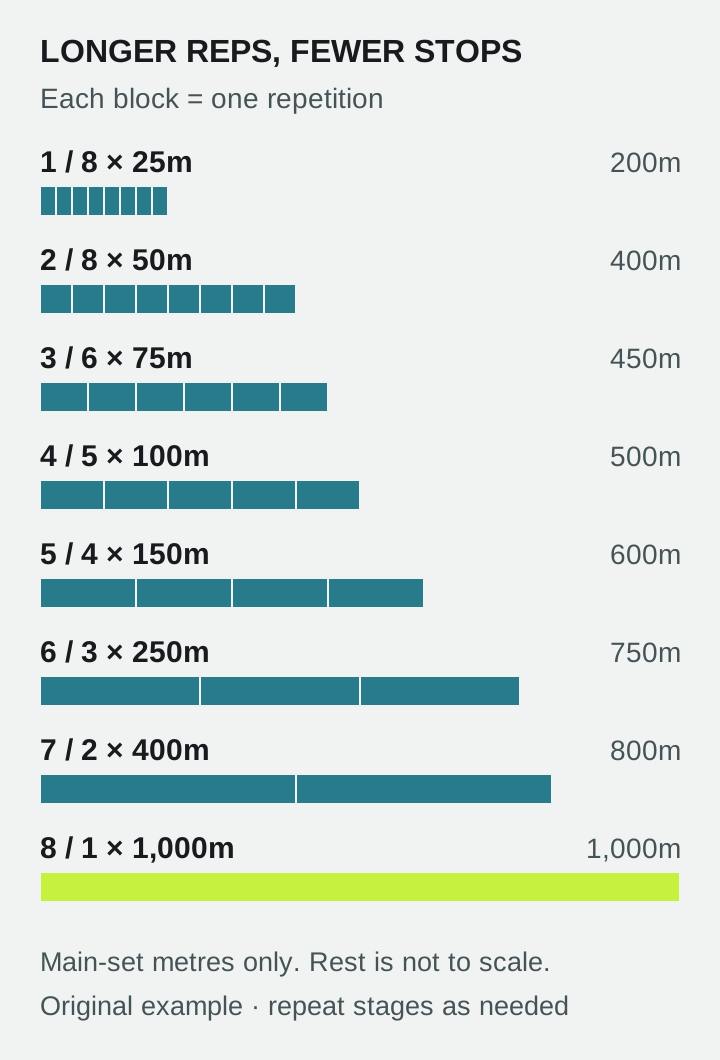
Start with short repetitions, practise twice a week, and lengthen the repetitions when you can finish them with control. The example below works from 8 × 25m to a continuous 1,000m. Each row can take a week or longer. There is no pace target and no deadline you have to force.
Before you start
This is for adults who already run, lift or ride and can swim 25m of front crawl comfortably, then repeat it after a rest. You should be comfortable putting your face in the water, returning to the wall and getting out safely. If you are still learning those skills, start with swimming lessons; a distance schedule cannot teach them for you.
Use a lifeguarded pool and swim with a buddy, in line with American Red Cross swimming safety guidance. This plan assumes a 25m pool. The 25m and 75m repetitions do not fit a 50m pool without an appropriate stopping point; use a shorter pool or have an instructor adapt the sessions. Do not plan a rest halfway down a deep lane.
The calendar, distances and progression checks are original coaching examples, not a research-tested programme. Swim England's own fitness training guide supports choosing a starting session for your experience and repeating sessions when appropriate. It does not validate this particular eight-week schedule.
The eight-week swimming plan
Book two pool visits with a non-swimming day between them, such as Tuesday and Friday. Repeat the same main set on both visits. These are practice sessions: choose an effort you can keep steady through the last repetition.
For each visit, add 4 × 25m easy to warm up and 4 × 25m easy to finish, resting at the wall as needed. A comfortable stroke is fine for those easy lengths. That adds 200m to the main set. The last column below includes it; all distances are per visit, not weekly totals.
| Week / stage | Main set | Rest between reps | Main set total | Whole visit |
|---|---|---|---|---|
| 1 | 8 × 25m | 30 sec | 200m | 400m |
| 2 | 8 × 50m | 30 sec | 400m | 600m |
| 3 | 6 × 75m | 30 sec | 450m | 650m |
| 4 | 5 × 100m | 30 sec | 500m | 700m |
| 5 | 4 × 150m | 20 sec | 600m | 800m |
| 6 | 3 × 250m | 20 sec | 750m | 950m |
| 7 | 2 × 400m | 20 sec | 800m | 1,000m |
| 8 | 1 × 1,000m | No planned stops | 1,000m | 1,200m |
How to read a set: 5 × 100m means swim four lengths of a 25m pool, rest at the wall, then repeat until you have done five repetitions. The 30-second rest is between repetitions, not after every length. Use the suggested rest as a starting point; take longer if you need it, and repeat the stage before making the swim harder.
The final row is an attempt you earn by being ready for it. If the first 1,000m feels controlled and you recover normally, you can repeat it on the second visit. Otherwise, use the second visit for an earlier comfortable set.
Move on when both visits feel controlled
Use these practical checks before moving to the next row:
- You complete every repetition without an unplanned stop in the middle.
- You can keep your breathing rhythm and stroke organised through the last repetition.
- The suggested rests are enough to start again comfortably, without rushing to beat the clock.
These are coaching checks, not a fitness test with a validated pass mark. If a row feels too hard, repeat it, extend the rest or return to shorter repetitions. If every 100m breaks down after 50m, practise controlled 50s instead of rehearsing the same struggle five times.
Both total distance and uninterrupted distance rise in this plan. Going from 2 × 400m to 1 × 1,000m is a substantial change. A bridge such as 2 × 450m and then 2 × 500m, each with enough rest to recover, is an option if you need more stages. Those sets total 900m and 1,000m respectively, but neither is yet a continuous 1,000m.
What a complete week-four visit looks like
Keep the session simple enough to remember at the wall. Warm up, do the main set, then finish easily.
| Part | What to swim | Distance |
|---|---|---|
| Warm-up | 4 × 25m easy; rest as needed | 100m |
| Main set | 5 × 100m front crawl; 30 sec between reps | 500m |
| Easy finish | 4 × 25m easy; rest as needed | 100m |
| Total | One complete visit | 700m |
If an instructor has given you a technique drill, add it while you can practise it well and count its distance separately. For example, four extra 25m drill lengths add 100m, bringing this visit to 800m. A drill is useful because it addresses something in your stroke; you do not need an arbitrary drill block to make a session look complete.
Breathing: make each length easier to repeat
Try one cue at a time on the short repetitions:
- Exhale while your face is in the water. Avoid holding everything in and trying to breathe out and in during the same brief head turn.
- Turn to the side with your body. Avoid lifting your head forward to find air.
- Keep the stroke rhythm through the breath. Aim for a movement you can repeat without a scramble at the end of the length.
These cues follow Swim England's front-crawl breathing guidance. They are things to practise, not a diagnosis of why you feel out of breath.
You do not have to breathe every third stroke. Swim England's front-crawl technique guide explicitly says breathing frequency is not fixed. A two-stroke rhythm is an option if it lets you breathe comfortably. Do not turn a distance session into a breath-holding challenge to satisfy a pattern.
Start the next repetition more gently if you keep arriving at the wall gasping. If short, easy lengths still feel unmanageable, ask a swimming teacher to watch your stroke and breathing before adding distance. Running fitness alone cannot tell you which part needs work.
Fit the swims around running and lifting
For a runner or lifter adding a new sport, two pool visits already change the training week. Start by replacing an optional conditioning session or shortening another session, rather than automatically adding both swims to an already full calendar.
Choose days when you can pay attention to technique. If swimming after upper-body lifting leaves your arms too tired to hold your stroke, move the swim or reduce that day's gym work. If you are in an important race block, maintaining your current swim stage may fit better than progressing every week. These are scheduling choices for this example, not a fixed recovery-window rule.
Keep a short note after each visit: main set completed, rest used, longest controlled repetition, and what interrupted it. “5 × 100m, 30 seconds rest, last two felt rushed” is more useful for choosing the next session than total metres alone. Use a watch if it helps you record the visit, and correct your log when you know the set was different.
If you miss a session
If you swim only once that week, repeat the stage on your next visit. Avoid squeezing two visits together to catch up with the table. After a longer break, start with a set you previously found comfortable and decide from how it feels. Eight rows may take ten or twelve weeks; the dates do not change the skill you are practising.
Your first continuous 1,000m
Choose a day when your recent longer repetitions feel manageable. Warm up as usual, then begin at an effort you could imagine holding beyond the first few lengths. Keep using the turns; this goal does not require tumble turns or giving up the wall push-off.
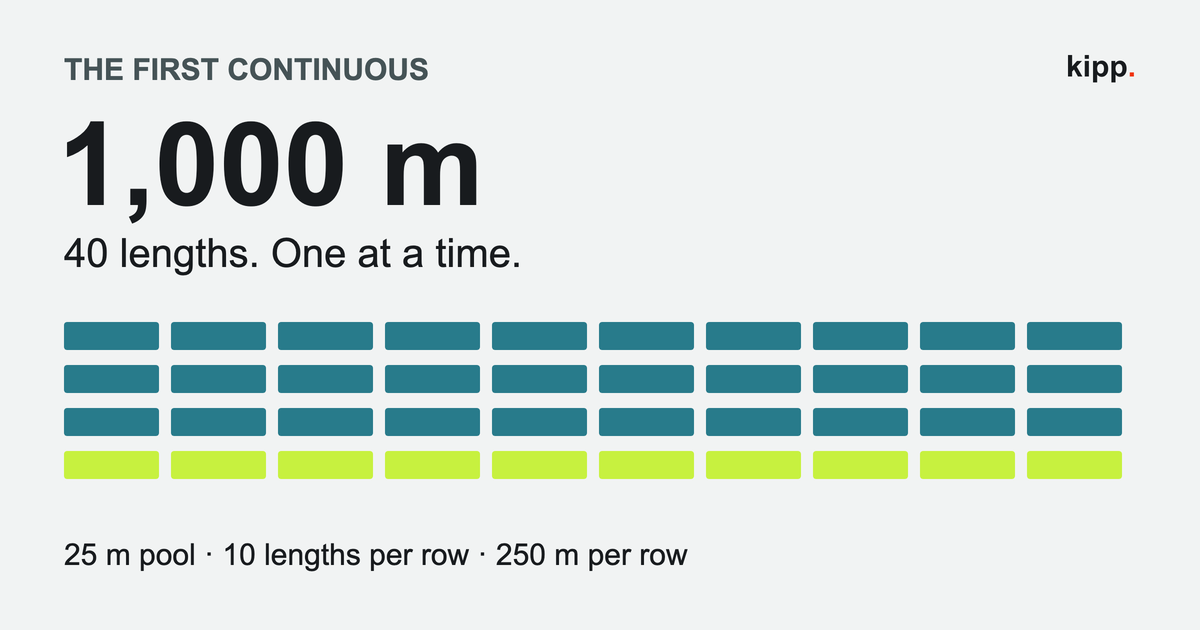
In a 25m pool, count 40 lengths. Four groups of ten can make the count easier: 250m, 500m, 750m, 1,000m. Those are counting checkpoints, not scheduled rests. A length is one trip from one end to the other. In a 50m pool the final distance is 20 lengths, although the earlier sessions need adapting as described above.
For this goal, “continuous” means swimming and turning without a rest stop. If you need a pause, take it. Record the longest continuous part and what you completed overall, then use that information for the next visit. Pain, dizziness or distress is a reason to stop and seek help, not a cue to complete another length.
A pool 1,000m is a pool milestone. It does not establish that you are ready for open water, where the conditions and safety arrangements are different.
Questions before your next visit
Does 1,000m include the warm-up?
The goal is 1,000m in one continuous main set. With the example's 100m warm-up and 100m easy finish, that visit totals 1,200m. Earlier sessions can reach 1,000m overall while still containing breaks.
What if my pool measures yards?
Keep yards labelled as yards. Forty lengths in a 25-yard pool is 1,000 yards, which is 914.4m. For this metric-distance target, 44 lengths is 1,100 yards, or 1,005.84m. The shorter repetitions can be adapted to yards, but their totals will then be different from this table.
Can I use breaststroke?
This progression is written around front crawl. A comfortable alternative stroke is fine for the warm-up and easy finish. If you change stroke during the main set, record that so you know what you actually practised. For a breaststroke-specific progression, have a teacher adapt the plan rather than applying front-crawl breathing cues to a different stroke.
Sources and scope
- Swim England: swimming fitness training plan (2017). Session structure and adapting the starting point; its separate 20-session programme is not the plan above.
- Swim England: improve your breathing in front crawl (2018). Exhaling underwater, turning to breathe and maintaining rhythm.
- Swim England: improving front-crawl technique (2018). Breathing frequency is flexible.
- American Red Cross: swimming safety. Supervised swimming and the buddy principle.
Sources checked on 21 September 2026. This is an original training example informed by coaching guidance, not a study with participants or evidence that everyone can reach 1,000m in eight weeks.
If you are fitting these swims around running and lifting, tell Kipp what you actually completed and how it felt. Ask how your next pool visit fits with the rest of your training week. A swimming teacher can assess the technique that a conversation cannot see.