The morning run went well. By the evening lift, the warm-up feels harder than it should, and you realise lunch was a small salad between meetings.
Before looking for a special recovery product, look at the hours between the two sessions. The practical job is to eat enough across that gap, with carbohydrate-containing meals and some protein, instead of waiting until both workouts are over.
The short answer
After the run, have a normal meal containing carbohydrate and protein. Eat lunch, then use an afternoon snack or small meal to arrive at the lift comfortably fed. The amount depends on the sessions, your daily needs, appetite and what your gut tolerates.
This article is for healthy athletes already combining running and lifting. The worked example is a food-planning illustration, not a diet prescription or medical advice. It does not estimate your calorie requirement from a watch's workout burn.
An eleven-hour gap is different from a rapid turnaround
The ISSN nutrient-timing position stand separates urgent glycogen restoration, with less than four hours between demanding efforts, from ordinary meal planning. For that rapid-recovery situation it discusses carbohydrate intake of 1.2 g/kg per hour. That is not an instruction to repeat the same hourly intake all day between a short morning jog and an evening gym session.
The same review emphasises total daily protein and describes intermediate protein servings of around 20-40 g spread through the day. It is a position stand drawing on multiple studies, not one trial validating the menu below. No pooled participant count is claimed.
For an ordinary workday gap, regular eating opportunities are a useful place to start. Avoid turning a conditional sports-nutrition strategy into a rigid countdown after every run.
Worked example: a 75 kg athlete
Assume a familiar 45-minute easy run starting at 07:00 and a familiar 60-minute lift starting at 18:00. The run ends around 07:45, leaving about ten hours and fifteen minutes before lifting. The start times are eleven hours apart; the recovery gap is shorter.
The following carbohydrate and protein amounts are original example checkpoints. Food descriptions are meal ideas, not measured recipes whose ingredients are guaranteed to match those numbers. Use package labels and actual portions when you want a closer calculation.
| Eating opportunity | Example carbohydrate | Example protein | Possible food direction |
|---|---|---|---|
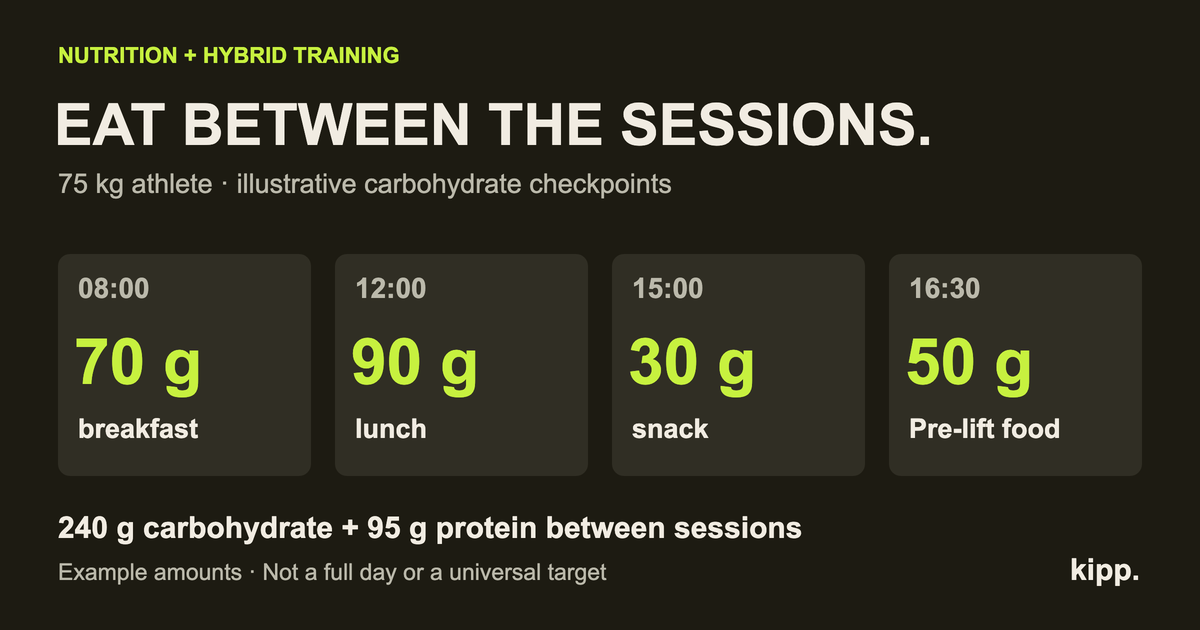
| 08:00 breakfast | 70 g | 25 g | Oats, milk or a suitable alternative, fruit and a protein source |
| 12:00 lunch | 90 g | 30 g | Rice, potatoes or bread with a familiar protein and vegetables |
| 15:00 snack | 30 g | 20 g | Fruit and a protein-containing snack, adjusted to appetite |
| 16:30 pre-lift food | 50 g | 20 g | A familiar sandwich or another comfortable small meal |
| Between-session total | 240 g | 95 g | Part of the day, not its complete intake |
That is 3.2 g/kg of carbohydrate between the sessions for this fictional athlete, calculated as 240 divided by 75. It is not a recommended daily carbohydrate target and is not being presented as this athlete's measured requirement. Pre-run food, dinner, dietary fat, fruit and vegetable variety, and any later snacks still need to fit the full day.
The 16:30 food is 90 minutes before lifting. Treat that as a trial arrangement: eat earlier, reduce the portion or choose something easier to digest if fullness affects the warm-up. You do not need to force the same meal schedule onto an early lunch break or a different session time.
Make the example usable without weighing everything
Start by checking whether you are missing an entire eating opportunity. A substantial breakfast and lunch may solve a different problem from adding a second protein shake to an otherwise sparse day. Include a familiar carbohydrate source and a protein source at the main meals.
Then look at the afternoon. If lunch is early, a familiar snack can be easier to fit than a large meal immediately before squatting. If lunch is late and substantial, the same snack may be unnecessary or need to be smaller.
The checkpoint amounts are not a pass-or-fail score. Record enough context to notice whether you arrive hungry, overly full, or consistently low on energy. Make one change at a time instead of redesigning the entire diet after one difficult workout.
If the run is longer or harder
The example's easy 45 minutes cannot stand in for a long run, hard intervals or a HYROX simulation. Those sessions change the day's demand and may require food during exercise as well as between sessions. Revisit the whole day instead of assuming one extra snack covers every increase.
For a genuinely short turnaround after demanding work, the position stand's rapid-restoration discussion becomes more relevant. At 75 kg, 1.2 g/kg per hour calculates to 90 g per hour. That is a conditional recovery strategy to personalise, not a second target to add automatically to the example table. A sports dietitian can help when high training volume, digestive problems or competing goals make the plan difficult.
If you are cutting weight
Do not make the gap between two sessions the place where the whole deficit accidentally lands. Review whether the total intake and the training demand can coexist, rather than trying to rescue an insufficient day with perfect timing. Our carbs-on-a-cut article explains how a calorie-constrained macro target can leave little room for carbohydrate.
Persistent fatigue or poor exercise tolerance has more possible causes than a missed snack. Food planning does not diagnose the problem or replace clinical assessment when symptoms persist.
Check the order as well as the food
Fueling is one part of a double-session day. An evening lower-body session can still be demanding after a hard morning run even when you eat between them. Our running and lifting on the same day guide helps decide which session should take priority.
Sources
- Kerksick et al. (2017): International Society of Sports Nutrition position stand on nutrient timing. Used for the distinction between rapid restoration and a longer gap, and the emphasis on daily protein and distributed servings.
- The 75 kg athlete, times, meal ideas and nutrient checkpoints are original illustrative arithmetic, not measured intake or a validated menu.
Kipp can discuss today's planned training alongside the meals you have actually logged. If lunch is already in your record, ask about the remaining gap before the lift rather than entering it again. Photo-based meal macros are estimates; absent meal records stay unknown rather than proving you did not eat.