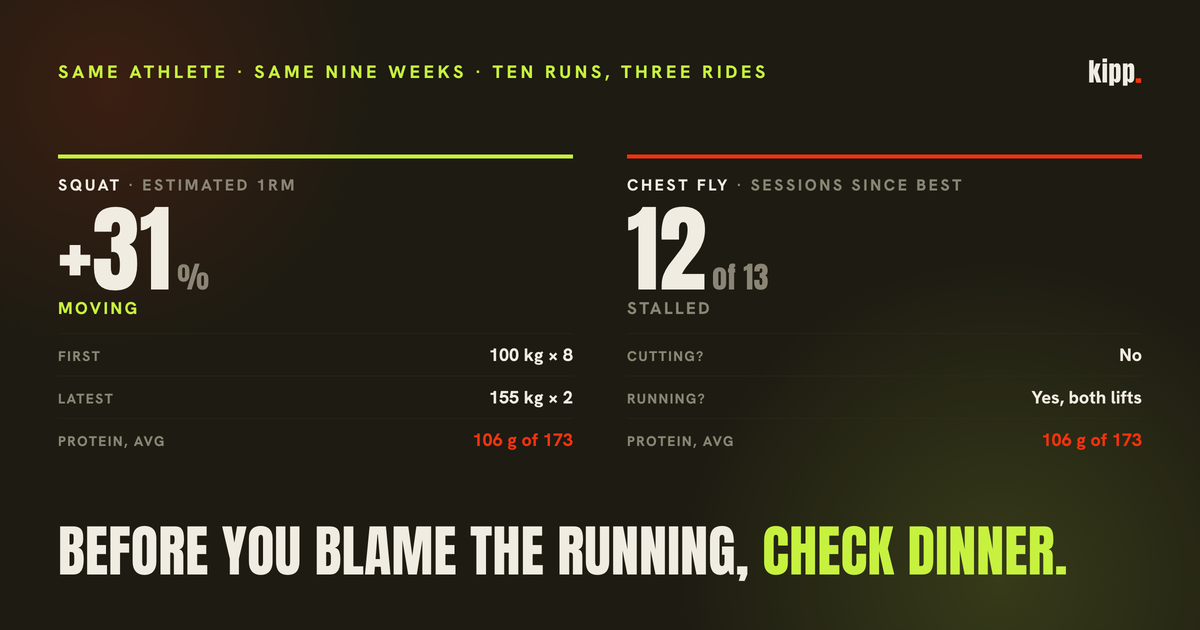
On our roster in September 2026, eight athletes have enough logged sets to compute a strength trend, across 68 distinct lifts. Nine of those lifts have five or more sessions on record. Exactly one meets the definition of a plateau our software uses: a chest fly, 13 sessions logged, 12 of them since its best.
The athlete it belongs to runs. Ten runs and three rides in the same ninety days, which is the profile that gets "interference" typed into a search bar. Over the same nine weeks his squat went from an eight-rep set at 100 kg to a double at 155, an estimated one-rep max up 31%. And he was eating, on average, 106 grams of protein a day against a target of 173. The stalled lift, the moving lift and the shortfall belong to the same person, and that is the whole article.
The short answer
Interference is real, and the pooled evidence says it lands on explosive strength, not on maximal strength. Adding running to a lifting programme reduced jump and sprint gains in a 43-study meta-analysis, but did not significantly reduce one-rep-max gains or muscle growth. Before you attribute a stalled squat to the running, check three things in order: whether the log is counting one lift (name splits hide plateaus), whether you are fuelled (under 85% of your protein target, it is a food problem), and whether you are in a deficit (holding load while losing weight is progress). Only a lift that clears all three, with at least five sessions and four since its best, is a stall the programme should answer.
What the research actually says, with the sample sizes
The idea has a birthday. Robert Hickson's 1980 study put three groups through ten weeks: strength only, endurance only, and both. The combined group's leg strength "was similar to the S group for the first 7 weeks of training, but subsequently leveled off and declined during the 9th and 10th weeks". Three groups, ten weeks, one strength measure, and the word "interference" in the title has been in every gym since.
Two things about that study are worth holding onto. The endurance load was six days a week of forty minutes, on top of five days a week of lifting, which is a great deal more running than most hybrid athletes do. And the cost appeared in weeks nine and ten, not week two.
The larger picture comes from two meta-analyses that partly disagree. Wilson and colleagues in 2012 pooled 21 studies and 422 effect sizes. Concurrent training's effect size for strength was 1.44 against 1.76 for strength training alone, for hypertrophy 0.85 against 1.23, and for power 0.55 against 0.91. Two moderators mattered: "resistance training concurrently with running, but not cycling, resulted in significant decrements in both hypertrophy and strength", and the decrements correlated with how often you did the endurance work (r from -0.26 to -0.35) and how long each session ran (r from -0.29 to -0.75). Duration was the stronger predictor.
Schumann and colleagues updated the question in 2022 with 43 studies, requiring each comparison to hold the strength prescription identical and add aerobic work to one arm. Their standardised mean differences were -0.06 for maximal strength (p = 0.446), -0.28 for explosive strength (p = 0.007) and -0.01 for hypertrophy (p = 0.919). Their conclusion: "concurrent aerobic and strength training does not compromise muscle hypertrophy and maximal strength development. However, explosive strength gains may be attenuated, especially when aerobic and strength training are performed in the same session." The same-session cost was significant (p = 0.043); separating the two by at least three hours was not. And unlike Wilson, they found no significant difference between running and cycling.
So the two largest pooled analyses agree that the cost is real and concentrated on power, and disagree on whether running is worse than cycling. What neither supports is the forum version, in which a few easy runs a week take a squat backwards. A one-rep max was the best-protected outcome in both.
What a plateau is, and what one is not
Before the question "is it the running" can be asked, a lift has to be stalled, and that is a definition, not a feeling.
Our software watches each lift's estimated one-rep max per session, computed from the best set by Epley's formula with an adjustment for reported RPE. It counts sessions since that estimate last set a best. It will not call a lift plateaued until there are at least five logged sessions of that lift and at least four since its best, and at least three weeks of training history behind the athlete. A bad day is not a plateau. A deload week is not a plateau. Re-hitting your best today counts as zero sessions since the best, not three.
Those thresholds are ours, and we set them conservatively on purpose, because "change your programme" is a large thing to say off a noisy signal. They are also only as good as the log they read, which brings up the thing that bit us first.
The name split that hid a real plateau
A lift can be logged as "Lat Pulldown" one week and "Pull Down" the next, and every per-lift count then splits in two. Neither half reaches five sessions, neither half shows a plateau, and the athlete is told the lift is moving because the software cannot see that it is one lift.
When we merged the aliases in our own data, only merging on space-insensitive containment and only where the residual was equipment or body-part words, two pairs collapsed and real numbers moved. One athlete's lat pulldown went from 6 sessions to 8, and its sessions-since-best from 5 to 7. His squat went from 4 sessions to 5 and its trend reached back to a previously orphaned session. The coach had been understating a plateau by two sessions because the log had two names for one movement.
The first check for a stalled squat is therefore the least interesting one: is the log counting one squat. Front squat, back squat, high-bar, SSB, "Squat" and "Squats" are five different lifts to a naive counter and one to you.
The two gates that come before the programme
Once a lift genuinely meets the plateau shape, our plan-progression code still refuses to propose a programme change in two situations, and the order is deliberate.
The first gate is fuelling. If the athlete's average protein over the recent window is below 85% of their target, the stall is not handed to the programme at all. The comment in the code puts it plainly: "A stall on a chronic protein shortfall is a food problem, and proposing a program change for it would send them to fix the wrong thing." There is no point adjusting volume, rep ranges or exercise order for someone whose muscle has not been given the material to adapt with.
The second gate is energy balance. If the athlete is cutting, the trigger does not fire, because "holding load while bodyweight falls IS progress, so a flat lift while cutting is the expected outcome, not a fault in the plan." A squat that stays at 140 kg while you lose five kilos is a squat that got relatively stronger. Calling that stalled, and then blaming the two runs a week, gets the diagnosis wrong twice.
Only a lift that clears both gates is treated as a stall the plan should answer, and even then the lever proposed is one change, a rep-range shift, a back-off week or more volume on that lift, never a restructure. Interference, as a hypothesis, sits behind all of that.
What the gates did on the real case
Back to the chest fly. Thirteen sessions, twelve since the best, the clearest plateau in the database. The athlete runs. The fuelling gate looked at 106 grams a day against 173, a ratio of 0.61, and declined to raise it. Nothing about running was ever evaluated, because the first honest explanation had already been found.
Two things about that case are uncomfortable and we would rather state them than tidy them. One: the plateaued lift is an isolation movement, and an isolation lift's estimated one-rep max is a noisy number, so our reassess scorecard already refuses to headline one as a regression. The plan-progression trigger, we noticed while writing this, does not apply the same filter; it picks the worst-plateaued lift by count. Had the athlete been fuelled, it would have proposed a programme change over a chest fly. That is now on the list to fix. Two: the athlete is the person writing this, which is the least flattering way to learn that your own software thinks your problem is dinner.
His squat, over the same nine weeks and the same ten runs, is the counter-example to the forum theory, and one athlete is not evidence of anything general. What it is evidence of is the ordering. The lift he cares about moved. The lift that stalled was under-fed. The running was present for both.
If it clears the gates, then look at the running
When a lift is genuinely stalled, the log is counting one movement, protein is on target and you are not cutting, the research gives you specific levers rather than a verdict.
- Separate the sessions. The one moderator that reached significance in the 2022 analysis was same-session training. Three hours apart removed the measurable cost to explosive strength.
- Look at duration before frequency. In the 2012 analysis, session length correlated more strongly with strength and hypertrophy decrements (down to r = -0.75) than how often you ran (down to r = -0.35). A fourth easy 30-minute run is a smaller intrusion than making two of three runs long.
- Decide what you are measuring. If the stalled quality is a jump, a sprint or bar speed, that is the outcome the evidence says running costs, and it is a real trade. If it is a one-rep max, the evidence says look elsewhere first.
- Give it the ten weeks. Hickson's cost appeared in weeks nine and ten under a six-day endurance load. A stall in week three of adding two runs is almost never that.
Running does interfere with something. In the pooled evidence that something is power, it is worse in the same session, and it scales with how long you run. Whether it is interfering with your squat is a question you can only ask once the log, the protein and the scale have each been ruled out, and on the one real case we have, they were not.
Kipp reads every logged set into a per-lift estimated 1RM, counts the sessions since each lift's best, and only calls a stall after five sessions and four without a best. Before it proposes a programme change it checks your protein against your target and whether you are cutting, and if either is the more likely explanation it says that instead of blaming the running.
Sources
- Hickson RC. Interference of strength development by simultaneously training for strength and endurance. Eur J Appl Physiol Occup Physiol 1980;45(2-3):255-63. Three groups, ten weeks; the combined group's strength gains "leveled off and declined during the 9th and 10th weeks". PubMed 7193134
- Wilson JM et al. Concurrent training: a meta-analysis examining interference of aerobic and resistance exercises. J Strength Cond Res 2012;26(8):2293-307. 21 studies, 422 effect sizes; running but not cycling produced significant decrements; frequency r -0.26 to -0.35, duration r -0.29 to -0.75. PubMed 22002517
- Schumann M et al. Compatibility of concurrent aerobic and strength training for skeletal muscle size and function: an updated systematic review and meta-analysis. Sports Med 2022;52(3):601-612. 43 studies; SMD -0.06 maximal strength (p = 0.446), -0.28 explosive strength (p = 0.007), -0.01 hypertrophy (p = 0.919); same-session attenuation p = 0.043. PubMed 34757594
- The stall definition (five sessions, four since best, three weeks of history), the 85% protein gate and the deficit gate are in our plan-progression code; the estimated 1RM uses Epley with an RPE adjustment. The 68-lift roster count, the chest fly, the squat trend and the 106-of-173 protein average are from our own data in September 2026, and the lat-pulldown merge from our July 2026 change log. Eight athletes and one stall; none of it generalises.